
As we head into Men’s Health Month this November, it’s a good time to talk about something many men deal with quietly: hair loss. For years, one medication in particular, finasteride, has been a go-to solution for those hoping to slow down or reverse balding.
But while it helps with hair, new research suggests it could also affect something much more important: your mental health.
What Is Finasteride and How Does It Work?
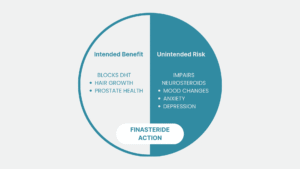
Finasteride is a prescription drug used to reduce hair loss and treat an enlarged prostate. It works by blocking the enzyme that converts testosterone into DHT, a hormone linked to both baldness and prostate growth.
Sounds good so far, right? But here’s the problem, this action also inhibits the production of certain neurosteroids, key brain chemicals like allopregnanolone, that are linked to mood regulation. When the production of these neurosteroids drops, it can sometimes lead to depression, anxiety, or even suicidal thoughts.¹
The Link Between Finasteride and Mental Health
Over the past few decades, researchers have noticed a pattern. Some men taking finasteride report serious mental health changes. Studies suggest that those using the medication may be more likely to experience depression or suicidal thoughts than men who aren’t taking it.¹
In 2022, the U.S. Food and Drug Administration (FDA) added a warning to finasteride’s label about the risk of suicidal thoughts and behavior.²
Interestingly, the risk seems to be higher in younger men (ages 18–44) who take the lower 1 mg dose for hair loss than in older men who take the 5 mg dose for prostate issues.²
So, while it might seem like a simple fix for hair loss, it’s not something to take lightly.
When Side Effects Don’t Go Away
For some men, the effects don’t stop even after quitting the medication. This is known as Post-Finasteride Syndrome (PFS), a condition where men experience ongoing issues like low sex drive, depression, anxiety, or trouble sleeping, even months or years later.¹
Not everyone develops PFS, but for those who do, it can be life-changing and difficult to treat. That’s why it’s so important to talk with your doctor before starting or stopping finasteride.
Why This Matters for Men’s Health Month
November, also known as Movember, is about more than growing mustaches. It’s a reminder to take men’s health seriously, not just physically but mentally and emotionally too.
The truth is, men are often less likely to speak up about how they feel. When you add in something like finasteride, which can quietly affect your mood, that silence can become dangerous.
Even though scientists are still studying exactly how finasteride and mental health are connected, there’s already enough evidence to say: pay attention.
If you’re taking or thinking about starting it, here are a few things to keep in mind:
-
Talk to your doctor about your mental health history before starting.
-
Pay attention to how you feel especially if you start feeling down, anxious, or unlike yourself.
-
Reach out right away if you notice new or worsening mood changes. Don’t wait.
The Bottom Line
Finasteride can help with hair loss, but it’s not risk-free. Your mental health matters more than your hairline.
This coming Men’s Health Month, let’s keep the conversation open about medications, about emotions, and about taking care of the whole person, not just what’s on the outside.
Concerned about the effects of finasteride or changes in your mood?
Schedule your discovery call today and explore safe, science-based ways to support your hair, hormones, and mental health naturally.
Sources:
¹ ScienceAlert. Decades of Studies Link Suicide Risk With Common Hair Loss Treatment. https://www.sciencealert.com/decades-of-studies-link-suicide-risk-with-common-hair-loss-treatment#
² Al Saffar, H., et al. (2023). U.S. Food and Drug Administration Warning Regarding Finasteride and Suicidal Ideation: What Should Urologists Know? European Urology Open Science, 52, 4–6. https://pmc.ncbi.nlm.nih.gov/articles/PMC10172713/